
Electrochemistry, batteries, and thermal management
(Click to expand) Li-S batteries (LSBs)
A major challenge in sulfur cathodes is LiPS formation during cycling, leading to rapid capacity fading. Sulfur/carbon (S/C) composites address these issues but are hindered by low specific energy, impractical electrode architectures, and scalability limitations. Semi-crystalline sulfocarbons like sulfurized poly(acrylonitrile) (SPAN) eliminate LiPS, enabling stable performance, low electrolyte-to-sulfur ratios, and higher energy density. The lithiation mechanism of SC2 cathodes, particularly N-doped materials like SPAN, remains poorly understood. N-dopants enhance capacity and stability by increasing quantum capacitance, as hypothesized from studies on N-doped graphene. To address limitations in S-loading and scalability, we propose optimizing N configurations, electrolytes, and scalable production for high S-loading SC2 cathodes. We are presently working on electrochemical impedance, in situ Raman and x-ray photoemission spectroscopy to experimentally map the redox density of states of SPAN. We are also endeavoring to make pouch cells containing SPAN cathodes with high S loading >5 mg/cm2.

(Click to expand) Battery thermal management systems (B-TMS)
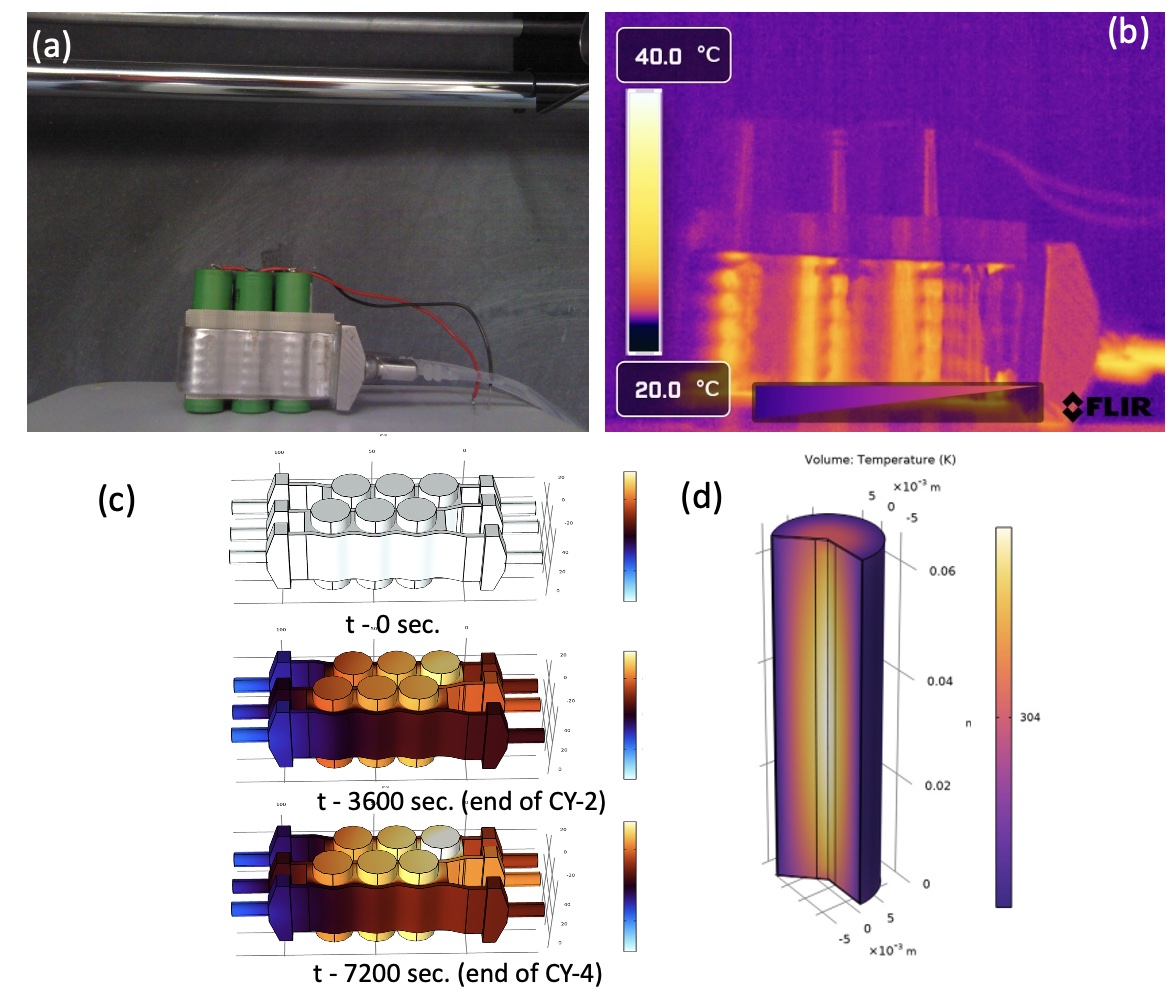
Battery thermal management systems (B-TMS) in electric vehicles (EVs) regulate temperature to maintain battery performance, longevity, and prevent thermal runaway. These systems generally use active air or liquid cooling, with thermal interface materials (TIMs) to dissipate heat, alongside sensors and control algorithms for temperature monitoring. Ideal B-TMS reduces both the maximum temperature (Tmax) and temperature variation (ΔT) across cells. Despite advances in air and liquid cooling, current B-TMS struggle to maintain uniform temperature (ΔT < 3 K) under all conditions and fully prevent thermal runaway. We are presently funded by the US Army GVSC to experimentally and theoretically investigate BN nanosheets (BNNs) for achieving high isotropic thermal conductivity. Furthermore, we are endeavoring to study phase change materials (PCMs), which absorb heat during phase transitions, to develop a hybrid system combining active cooling with PCMs to reduce Tmax, ΔT, and enhance safety.
(Click to expand) Machine learning for thermal characterization of thermal interface materials (TIMs)
Traditional thermal conductivity (TC) measurement methods often require extended measurement times and specialized equipment. These methods are particularly challenging when applied to heterogeneous materials or TIM composites relevant to battery packs. We recently developed machine learning (ML) based methodology to predict the TC of TIMs at temperature ranges relevant to battery pack operation (-40-80 oC). Our methodology involves using a material sample as a bridge between two Peltier modules. A known thermal gradient is applied across this bridge, causing heat to flow from one module to the other through the material. The resulting temperature distribution across the material is captured using an IR camera. A ML model is trained on a diverse dataset that includes thermal images of various well-known materials and composites to learn the relationships between the TC and thermal images. Once trained, the algorithm can be used to predict the thermal properties of new materials based solely on thermal images. This non-contact measurement technique method can be applied to a wide range of materials and devices, including chips that often require high TC interfaces. In our initial studies, by combining COMSOL simulation data and experimental IR imaging of some materials such as Cu, Ni, PDMS, glass etc., we trained a ML model capable of predicting TC. At present, the accuracy of this model is only 70-75% due to a limited dataset (~72 images), which we are working to improve by generating new datasets. We filed for an invention disclosure on this method. Our goal is to utilize this method to perform thermal characterization of TIMs and SSEs relevant to energy storage devices. While the geometry in Fig. 4a is used for in-plane TC, we employ a similar setup with two IR cameras to determine the cross-plane TC.

(Click to expand) Solid-state electrolytes
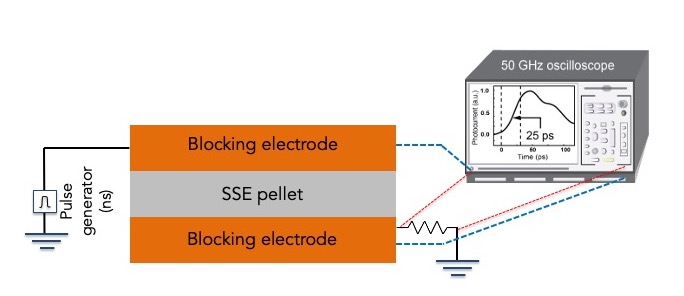
In this project, we arel focused on optimizing the printing of SSEs, including LGPS (Li10GeP2S12), LLZO (Li7La3Zr2O12), and LLTO(Li0.5La0.5TiO3), known for their high ionic conductivity and stability in solid-state applications. We will systematically vary key printing parameters such as laser power, scan speed, layer thickness, and hatch spacing to achieve SSEs with optimal ionic conductivity and microstructural properties. We will explore lower laser power to enable controlled sintering that preserves grain boundaries for improved ion transport, while higher power settings will allow full densification, targeting reduced porosity and grain boundary resistance. By adjusting scan speed and layer thickness, we will precisely control energy input and thermal gradients to influence grain size, grain boundary density, and overall densification.
 Laboratory of Nano-BioPhysics